Fire-safety basics
Accessible questions covering common household and community fire-safety topics.
Public demo
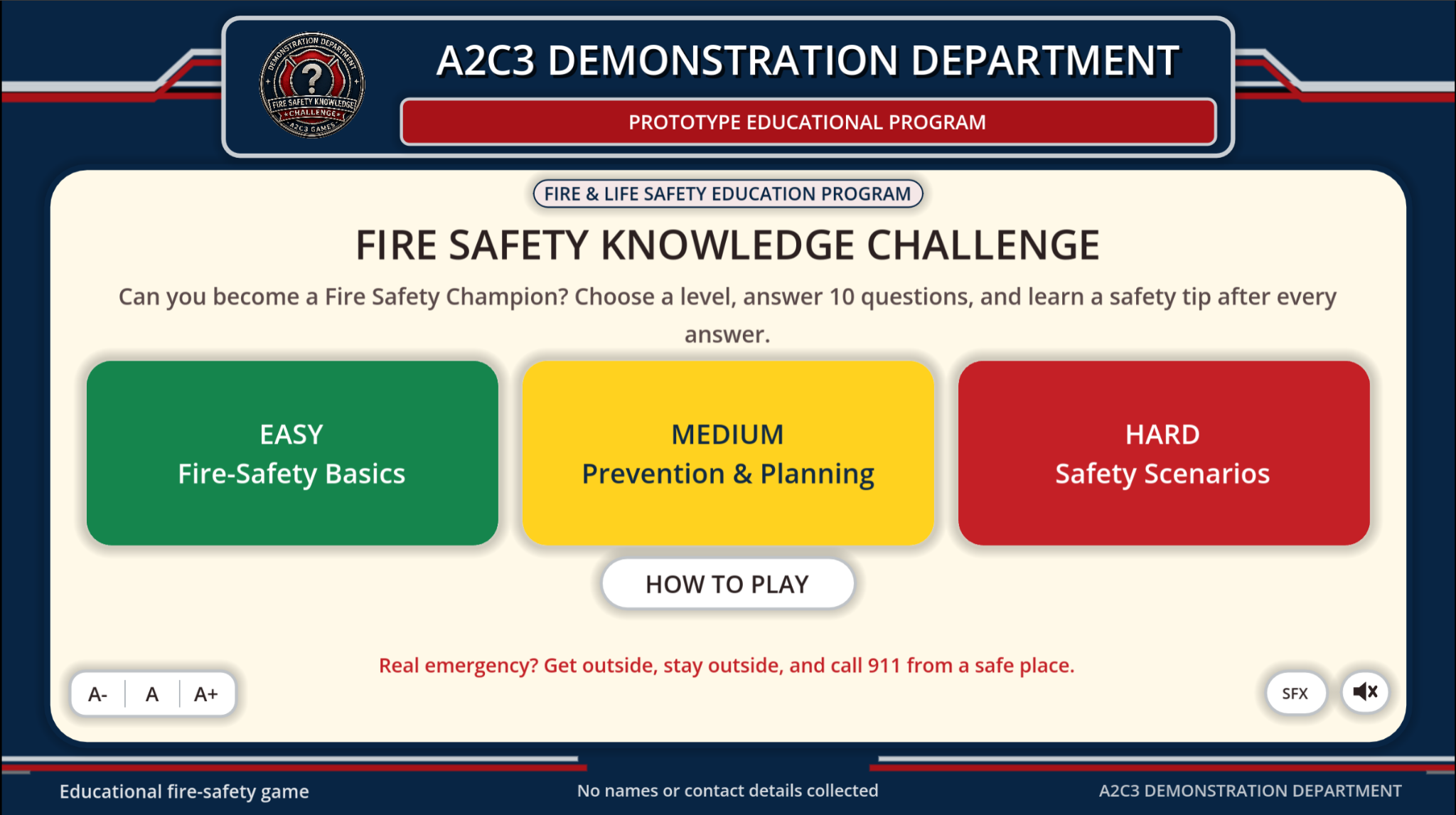
Answer 10 randomized questions from a maintained 300-question fire-safety bank. Choose a learning path and receive a safety tip after every answer.
Before you play
In a real emergency: leave the dangerous area, call 911 from a safe location, and follow emergency responders.
No account, name, email address, or exact location is required to play.
How it works
The game calls these choices categories. Each learning path includes questions across multiple fire-safety topics.
The challenge introduces and reinforces fire-safety concepts while helping departments see which topics may need stronger outreach.
Accessible questions covering common household and community fire-safety topics.
Questions that reinforce prevention, preparation, alarms, escape planning, and safer decisions.
Scenario-based questions that ask participants to select a safer response and review the reason.
Question bank at a glance
The challenge is not a short list of generic trivia. Its current release contains 300 questions organized across 19 fire- and life-safety topic categories, three learning paths, and multiple ways to ask participants to recognize hazards, make safer decisions, and think through preparation and response.
Battery Safety · Electrical Safety · Kitchen Safety · Heating Safety · Laundry Safety · Flame & Fuel Safety
Smoke Alarms · Carbon Monoxide · Calling 911
Home Escape · Family Communication · Firefighters & Drills
Fire Extinguisher Awareness · Fire Sprinklers
Burn Safety · Special Locations · Fire Misuse & Peer Safety
Outdoor Fire Safety · Seasonal & Holiday Safety
Questions are maintained with source references and reviewed against materials including the NFPA Educational Messages Desk Reference and fire-service education guidance, U.S. Fire Administration resources, CPSC guidance, Ready.gov, National 911 resources, and other identified public-safety references. The interaction and message framing are also informed by the Johns Hopkins Center for Injury Research and Policy study conducted for NFPA on fire and life-safety messages for children.
Source-informed does not mean NFPA- or Johns Hopkins-endorsed, independently field-validated, or a guarantee of learning or behavior change. The question bank is an educational resource, not certification, emergency guidance, or a substitute for local instruction.
Inside the program
Departments can review aggregate starts, completions, scores, pass rates, topic and question patterns, learning-path activity, and campaign attribution.
Useful for Fire Prevention Week, school outreach, community events, CRR planning, and participation documentation that may support grant reporting.
Educational practice. A quiz score reflects this round, not a certification.
General education only. The challenge does not provide certification, a code-compliance determination, legal advice, or emergency guidance.
A score reflects one quiz round. It does not prove durable learning, behavior change, or community-wide knowledge.
Activity becomes privacy-minimized aggregate reporting rather than named participant profiles.
Supporting sources are available upon request; references do not imply endorsement. This is a pre-launch demonstration. Review the Privacy notice and Terms.
See real question examples and how survey questions are selected